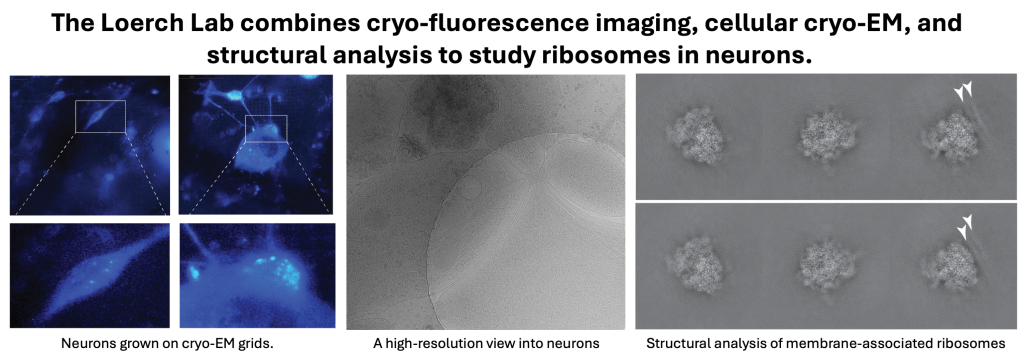
Chronic pain and many neurological disorders are associated with long-lasting changes in neuronal function. These changes depend on tightly regulated protein synthesis, yet we still know remarkably little about how this process is controlled at the molecular level. The Loerch Lab investigates how ribosomes, the molecular machines that build proteins, are regulated during neuronal signaling, plasticity, and disease.
Our research combines cryo-electron microscopy, in situ structural biology, biochemistry, cell biology, and computational approaches to study protein synthesis in its native cellular context. Rather than focusing only on isolated molecules, we aim to capture ribosomes inside cells, where we can observe how translation is organized, regulated, and remodeled in response to neuronal signals.
A major focus of our work is understanding how neurons locally regulate protein synthesis within axons and dendrites, enabling rapid responses to synaptic activity, stress, and injury. We investigate how signaling pathways reshape ribosome function, how distinct ribosome functional states influence translation, and how these mechanisms contribute to neuronal plasticity and disease-relevant cellular states.
In parallel, we develop structural and computational methods for large-scale analysis of ribosome functional states across cells, tissues, and organisms. By integrating technology development with fundamental biological discovery, our goal is to uncover the molecular principles that govern protein synthesis in the nervous system and identify new opportunities for therapeutic intervention in neurological disease.
More Info

Sarah Loerch, PhD
Assistant Professor
Department of Anesthesiology
University of Wisconsin
(608) 263-8100